If you want to join this blog, please send an email to andrew@amplifiers.com.au. |
|
Acoustic Combo Amp 18RR107 Acoustic ComboThis combo amp was designed for a customer with a fine collection of acoustic guitars fitted with high impedance piezo pick-ups and active LR Baggs pick-ups. The design brief was for an ultra-quiet ultra-clean amplifier for small gigs and recording work. The amp is fitted with a 3-spring Belton short reverb tank with a 12AU7 transformer coupled driver, with Dwell and Mix controls and a 12AX7 reverb recovery stage. The pre-amp is built using a high quality PCB which combines the integrity of hand-soldered joins, short signal runs and repeatable quality. The components used are a combination of ex-Soviet military oil caps, polypropylene caps and mica caps, carbon film power resistors and metal film resistors for superior tone and low noise. Bourns 20mm pots are fitted as standard. Signal tubes are a mix of new factory 12AX7 and NOS 12AU7. A premium version could be fitted with 6SL7 and 6SN7 octal pre-amp valves. The PCB is fitted with a Tone Module turret board which can be tailored for any tone stack, and works in an unusual feedback design as described in Valley & Wallman, Vacuum Tube Amplifiers, 1946. The power amp is a 6V6 cathode-biased valve-rectified amp, with 23watts peak on the bench (17 watts RMS), using a pair of AWV Australian made power valves. Valve rectification is provided by a NOS military GZ34. The standard pre-amp design can be combined with different power stages to provide 25, 35, 45 and 55 watt variants, depending on the power valves and transformer sets used.
The acoustic amp cabinet is an unusual design, inspired by the Humphrey Espresso 15 acoustic amp from the UK, and is fitted with a sealed back and a front facing speaker vent. The selected speaker is a Weber NeoMag 10", designed by Weber to have the same magnet circuit energy and voice coil characteristics as the original JBL alnico D110F speaker - "broad, smooth, uncoloured, strong low end." The main speaker is complemented by a Rola 3" x 7" mid-range tweeter for a wider high frequency response. This unique cabinet is finished with a laser etched wooden plaque with personalised "guitar, branch and bird" art work provided by my customer. Harp Amp - Alamo Redux This amp is a complete rebuild of an Alamo Montclair Reverb amp from the 1970s.
Customer feedback, received by email. I have played through some vintage aussie valve amps , found them a bit bland. Played through custom 5 watt amps and sure you get the grunt but no depth of sound. Played through some big watt prestigious valve amps but they are still too clean a sound. Your amp has a great tonal range and depth of sound. A great sounding amp for harp playing both blues, and playing in sultry minor keys . Used the reverb and tremolo and played fine - Sounds really good with a minor key harp and with a F# minor key harp. This amp will give me inspiration to keep playing. I’m starting to control the feedback with the inline volume control on my mic with the volume set at the 9 o’clock setting before I get feedback. I’ve found that it gets a lot louder when you blow harder. A response I don’t get from my solid state amp. I have been using the low gain input to get greater volume although the high gain input has a lot more crunch for playing cross harp blues in second key. I’m glad I have my inline mic volume control to maximise output and control feedback. The footswitch is a really nice looking unit that matches my model 52 brushed chrome Shure bullet mic and alloy inline volume control. Next week at jam night at the pub is lining up to a good night with few good muso’s turning up that have been away all wanting to here this new amp. One mate who is looking for a Princeton amp might find this amp very interesting. Next week at band practice with the covers band I play with should be good. I reckon our lead guitarist with a 1965 blackface 20 watt Deluxe Reverb will be very interested after I’ve been raving on about this amp for so long. Thanks for
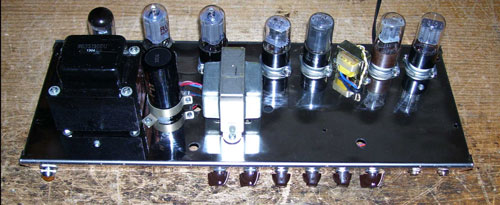
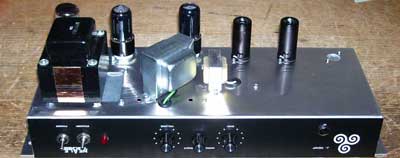
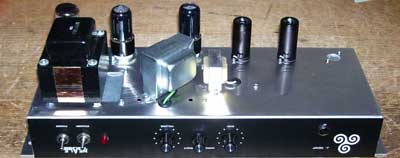
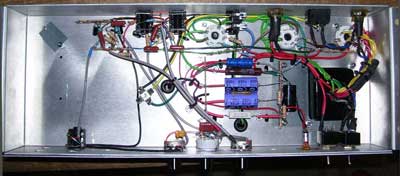
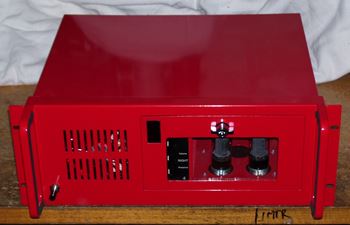
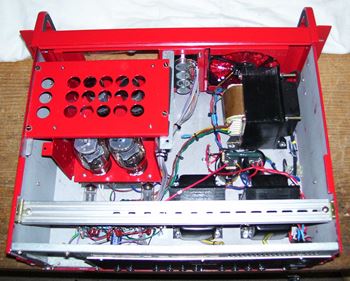
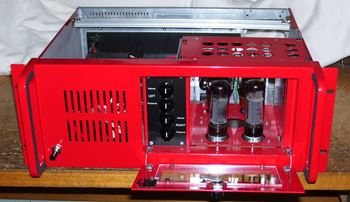
building me such a nice sounding Amp. Regards, Robert Ampeg VT40 Clone I've just finished testing a clone build of an Ampeg VT40 guitar amp.![]() ![]() The amp has been built on an old PA amp chassis, originally designed for a quad of 7027A power tubes. Since the VT40 design only requires a pair of power tubes, I've taken the opportunity to do a couple of mods to the original circuit. Firstly, the phase splitter and the reverb driver are now 6SN7 octal triodes. Second, I've replaced the original 6K11 three-triode valve with a 12AX7 and half a 12AU7. The other half of the 12AU7 is now used to drive the middle/centre controls (using a switchable choke as well as a Middle control pot. The amp uses the original power transformer with a voltage doubler supply, giving 535 volts (no load). Full power is 65 watts RMS. Control configuration is: - single input feeding two separate 1st gain stages (for Normal and Lead channels). - each channel has Boost, Cut and Bright switching, and its own Gain control. - channels combine in the 2nd stage, and then the signal goes to a Baxandall Bass Treble tone stack. - the output of tone stack is then fed through a 3rd gain stage into the Middle and Centre drivers. A cathode follower drives the Centre switched choke assembly (providing three different frequency selects) and the Middle tone pot. VT40_Equalisation.pdf - the Reverb takes off from the tone stack, and goes through its Dwell control, into a transformer driven Belton 9" three-spring reverb tank. - the EQ signal and the reverb recovery (Mix) then combine at a second cathode follower stage which drives the Master Volume and the power amp. - the power amp has a half-12AX7 volt amp driving a floating paraphase phase splitter (6SN7), and finally a pair of 7027A beam pentodes. ![]() ![]() |
www.amplifiers.com.au |